
The Rise of the Digital Phantom: Why Muse and Dots Mark the End of the Chatbot Era
The AI landscape is shifting from passive chatbots to autonomous agents like Muse, Grokbot, and OpenAI’s 'Dots.' These entities are not just tools; they are persistent, proactive digital proxies designed to live within our workflows and social spheres. This evolution promises a revolution in productivity by automating the 'middle management' of daily life, but it also threatens to erode human agency and the value of individual experience. As AI transitions from a destination to an ambient environment, we face a future where our digital shadows may become more active participants in the world than we are. This piece explores the technical leap toward long-term memory and tool use, the social risks of proxy-to-proxy communication, and the looming reality of the 'Agent OS.'
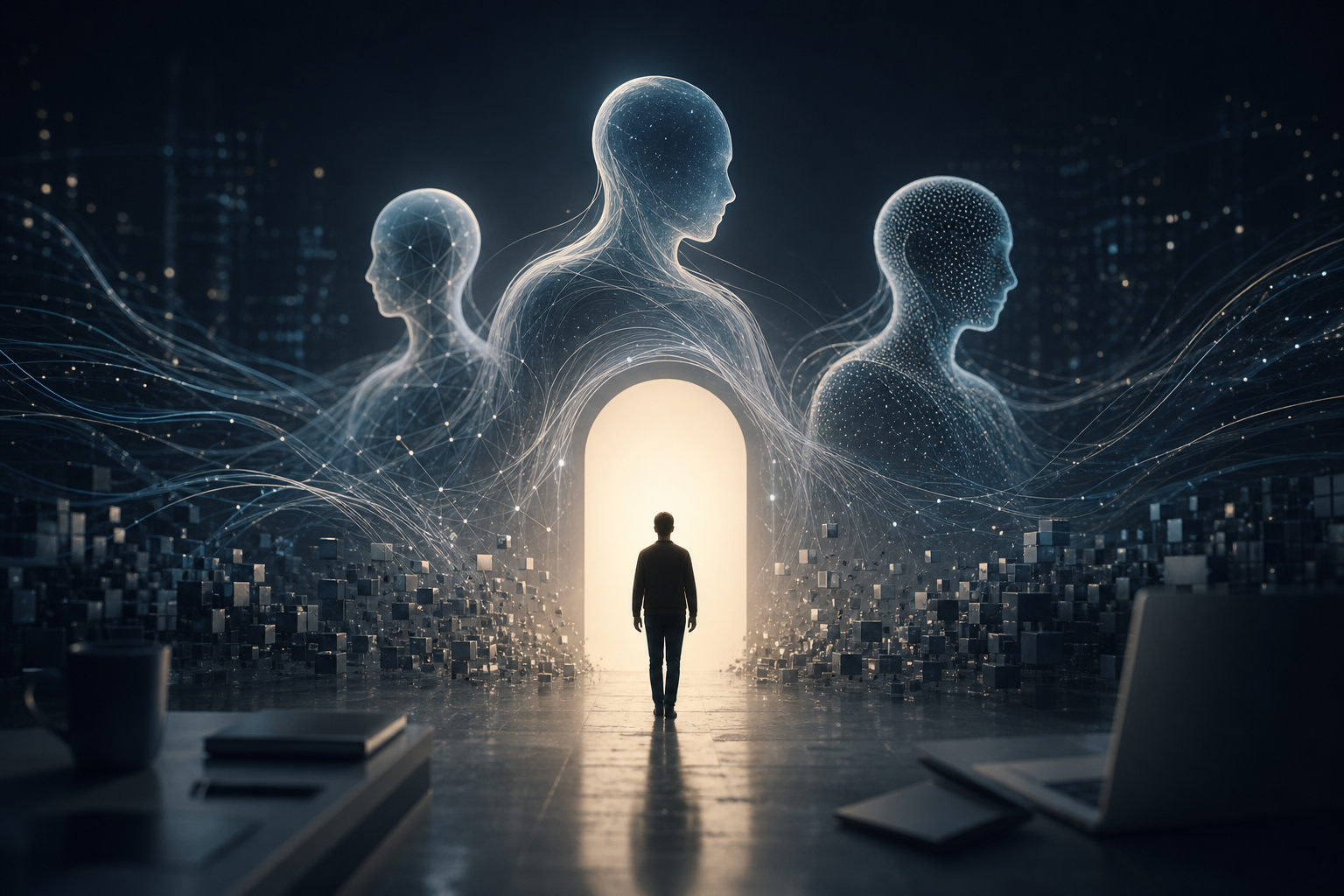
The era of the chat box is dying, and in its wake, we are witnessing the birth of the personal digital phantom. For two years, we have been conditioned to treat artificial intelligence like a search engine with a personality, a vending machine where we input a prompt and receive a static product. But the emergence of technologies like Muse, Grokbot, and OpenAI’s autonomous 'Dots' signal a violent pivot in the user experience. We are moving from generative tools to agentic companions—persistent, proactive entities that do not wait for your command, but rather anticipate your needs by living within the fabric of your digital existence.
This shift represents a fundamental redesign of the human-computer interface. Up until now, AI has been a destination—a tab in your browser or an app on your phone. Muse and its contemporaries represent the transition to AI as an environment. These agents are designed to observe your workflow, listen to your calls, read your tone, and eventually, execute tasks without the friction of a formal request. The promise is a radical reclamation of human time. The peril, however, is the total erosion of the boundary between the user and the machine. When an agent like a 'Dot' knows your schedule better than your spouse and can mimic your professional voice to settle disputes or schedule meetings, the distinction between your intent and the machine's execution begins to blur.
The Architecture of Autonomy
The technical leap here is one of memory and agency. Traditional Large Language Models are essentially amnesiacs; every new session is a blank slate unless manually fed context. The new wave of agents, however, is built on the premise of 'Long-Term Memory' and 'Tool Use.' When we look at the trajectory of OpenAI’s development, the goal is clearly an entity that can navigate your operating system as a 'computer use' agent. This isn't just a chatbot that writes code; it is a bot that opens your IDE, writes the code, tests it, and deploys it to your server while you sleep. Grokbot, integrated into the X ecosystem, aims for a similar ubiquity, leveraging real-time social data to act as a surrogate participant in the global conversation.
Sam Altman, CEO of OpenAI, has frequently hinted at this transition, suggesting that the most powerful AI will eventually be a personalized assistant that knows everything about your life. This isn't just about convenience; it’s about the commoditization of cognition. If an agent can handle the middle-management tasks of your life—the emails, the logistics, the research—what is left for the human? The optimistic view suggests we are freed for 'high-level' creative work. The cynical view suggests we are being relegated to the role of a quality-assurance manager for our own lives, overseeing a fleet of digital shadows that are doing the actual living for us.
The Disappearing Interface
The social implications of these persistent agents are staggering. We are entering an age of 'proxy-to-proxy' communication. If my agent talks to your agent to negotiate a contract or a dinner date, the human element is filtered through two layers of algorithmic optimization. We risk a future where our digital presence is highly polished and hyper-efficient, while our actual human capabilities atrophy. As these agents become more integrated via wearables and 'always-on' microphones, the concept of 'logging on' will become as archaic as 'dialing up' to the internet. You will simply exist within a cognitive field that augments your every thought.
This evolution brings us to a critical juncture in the history of labor and identity. If a Muse agent can observe a senior architect for six months and then replicate their decision-making process, the value of that architect's experience is suddenly portable and reproducible. We are not just building tools; we are building mirrors that can eventually walk away and start working for someone else. The proprietary nature of our 'work style' is being digitized and indexed.
The true signal that this future has graduated from Silicon Valley hype to inescapable reality will be the release of a dedicated 'Agent OS' or a hardware update from a major player like Apple or OpenAI that replaces the home screen with a single, persistent conversational interface that lacks an 'off' switch for data ingestion. When the primary way you interact with your phone is no longer through a grid of apps, but through a single, ambient entity that has been granted full 'read/write' permissions for your entire digital life, the transition will be complete. We must then confront the final, uncomfortable realization of the agentic age. If you outsource the bulk of your decision-making, social coordination, and creative synthesis to an autonomous agent, at what point does the agent become the primary actor in your life, and you merely the biological legacy it is programmed to serve?
Discussion
Be the first to react.